


 中文简体
At the heart of every reverse osmosis system sits a thin, unassuming membrane that does the heavy lifting of water purification. RO membranes are used in household drinking water purifiers, brackish water treatment, industrial process water, and even seawater desalination. But how does an RO membrane work? In this guide, we explain the principle, structure, and operating conditions behind this remarkable filtration technology, and what it means for choosing and maintaining the right membrane.
The Science Behind Reverse Osmosis
The term "reverse osmosis" only makes sense if you first understand normal osmosis. Osmosis is a natural process in which water moves through a semipermeable membrane from a region of lower solute concentration to a region of higher solute concentration, trying to balance the two sides.
Natural Osmosis vs. Reverse Osmosis
In natural osmosis, the driving force is the osmotic pressure difference. If you place saltwater on one side of a semipermeable membrane and fresh water on the other, pure water gradually travels into the saltwater side until the concentrations equalize.
Reverse osmosis simply reverses this flow. By applying external pressure to the feed side, at a level greater than the natural osmotic pressure, water molecules are forced to move from the high-concentration side to the low-concentration side. Salts and most other dissolved contaminants cannot pass through the membrane, so they are left behind in a concentrated stream, known as concentrate or brine water.
This is why an RO system always produces two streams: purified permeate and concentrated reject water.
Anatomy of an RO Membrane
Most modern RO membranes are thin-film composite (TFC) membranes, built from three distinct layers that work together.
- Non-woven polyester fabric: The backing layer that gives the membrane mechanical strength to withstand operating pressure.
- Polysulfone support layer: A microporous middle layer that provides a smooth, uniform surface for the active barrier.
- Polyamide thin film: The top active layer, less than a micron thick, that actually performs the rejection. This dense, cross-linked polymer allows water molecules to pass while blocking dissolved salts, organics, and microorganisms.
In a typical spiral-wound element, these flat sheets are sealed into envelopes, wrapped around a central permeate collection tube, and separated by mesh spacers that create flow channels for feed water and concentrate.
How Water Passes Through an RO Membrane
The movement of water through the membrane is not a simple sieve effect. It can be broken down into four stages:
- Pressurization: A pump raises the feed water pressure well above the osmotic pressure of the solution. In household systems, this is usually a 12V or 24V booster pump.
- Contact: Pressurized feed water flows across the membrane surface, and water molecules begin to dissolve into and diffuse through the polyamide active layer.
- Separation: Dissolved ions and organic molecules are repelled by the charged, cross-linked polymer structure and remain on the feed side.
- Collection: The purified water that emerges on the permeate side travels along the membrane envelope and into the central tube, while the concentrated reject stream is flushed out of the element.
This mechanism is often described as solution-diffusion: water partitions into the membrane material, diffuses through it, and emerges on the other side. Contaminants that cannot dissolve into or diffuse through the active layer are retained.
What an RO Membrane Removes
RO membranes are best known for rejecting dissolved salts, but their rejection range is much broader. The table below summarizes typical rejection rates for common contaminant groups.
| Contaminant category | Typical rejection rate | Examples |
|---|---|---|
| Total dissolved solids | 95-99% | Sodium, calcium, chloride, sulfate |
| Heavy metals | 90-99% | Lead, arsenic, chromium, copper |
| Microorganisms | Over 99.9% | Bacteria, viruses, cysts |
| Organic compounds | 90-98% | Pesticides, herbicides, VOCs |
Rejection rates depend on membrane type, operating pressure, water temperature, and the chemistry of the feed water. High-pressure membranes designed for seawater desalination, for example, are selected specifically for their salt rejection performance.
Key Factors That Affect RO Membrane Performance
A membrane does not work in isolation. Real-world performance depends on several operating conditions:
- Feed pressure: Higher pressure generally increases permeate flow, but exceeding the maximum operating pressure can damage the membrane.
- Water temperature: Membranes produce more water at higher temperatures. As a rule of thumb, flow changes by about 3% per degree Celsius.
- Feed water TDS: A higher salt load means higher osmotic pressure, so more energy is needed to achieve the same flow.
- pH level: TFC membranes usually operate best in a pH range of about 2 to 11. Extreme values can degrade the polyamide layer.
- Fouling and scaling: Suspended particles, biological growth, and calcium scaling block the membrane surface and reduce performance over time.
The RO Membrane Within a Complete System
A membrane only delivers clean water when it is supported by the rest of the system. In a typical household RO purifier, the membrane works alongside sediment filters, activated carbon cartridges, a booster pump, and solenoid valves.
Incoming water first passes through a PP sediment cartridge to remove particles, then through activated carbon to strip chlorine, which would otherwise damage the polyamide film. A pump raises the pressure to drive the membrane, while solenoid valves control flushing and shutoff. After the membrane, a post-carbon filter, such as a T33 cartridge, polishes the taste before the water reaches the faucet.
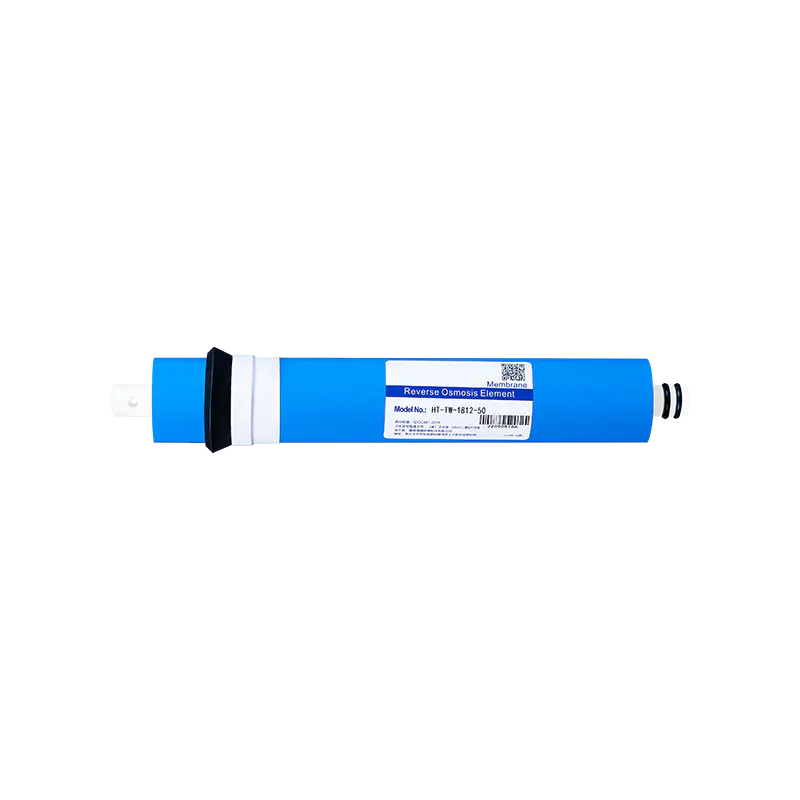 Household Reverse Osmosis Membrane Elements for Water PurifiersThis RO membrane completes the filtration system described above, removing impurities, bacteria, and viruses. Choose from models with varying flow rates and salt rejection to match your system.View Product →
This is why a membrane should not be judged in isolation. The performance of a complete system depends on every component working together. You can read more about how RO membrane filter cartridges ensure pure drinking water in our detailed guide.
Household vs. Industrial RO Membranes
Although the working principle is identical, membranes are engineered for very different scales and feed water conditions.
Household RO Membranes
Household membranes are compact spiral-wound elements, typically in 1812 or 2012 size packages, producing 50 to 100 gallons of permeate per day. They are designed for low pressure, high recovery, and simple replacement.
Industrial RO Membranes
Industrial elements, such as 4040 and 8040, are much larger and built for higher flow rates and tougher feed water. Specialized elements are available for different applications:
- Low-energy and extra-low-pressure membranes, such as the TW4040, reduce operating costs in brackish water treatment.
- Low-fouling, high-rejection brackish water membranes like the BW8040 resist organic and particulate fouling.
- Seawater desalination membranes such as the SW8040 are designed to reject salt at very high operating pressure.
 Industrial 4040 RO Membrane for High-Capacity Water TreatmentA larger element designed for tougher feed water and higher flow rates. Available in anti-pollution, high-flux, or high-desalination types, offering stable desalination up to 99.6%.View Product →
Choosing the right membrane means matching feed water quality, target permeate quality, and operating pressure, rather than simply picking the largest element available.
Maintenance Tips to Extend Membrane Life
RO membranes do not last forever, but with proper care, a household membrane can serve reliably for two to three years. Industrial membranes last even longer when the feed water is properly pretreated.
- Replace pre-filters on time: Sediment and carbon cartridges protect the membrane from particles and chlorine. Neglecting them is the fastest way to damage the membrane.
- Flush the system regularly: Automatic flushing solenoid valves help wash away rejected salts and foulants from the membrane surface.
- Monitor pressure and recovery: Operating outside the design range accelerates scaling and shortens membrane life.
- Watch for signs of aging: A noticeable drop in permeate flow, higher TDS in the product water, or a change in taste indicates that it is time for replacement.
Understanding how an RO membrane works makes it easier to choose the right membrane type, design a reliable system, and troubleshoot performance issues. The membrane is the core of reverse osmosis, but it is also the component that benefits most from proper pretreatment, pressure, and maintenance.
Whether you are selecting a household membrane for a drinking water purifier or an industrial element for brackish water treatment, getting the fundamentals right will save you time, water, and money. If you would like help identifying the right membrane for your application, contact our team.


